Friday, February 23, 2024

Helen Broderick (1891-1959) by Strauss-Peyton Studio

She made her Broadway début in the 1907 ZIEGFELD FOLLIES, as a dancer; her roles don’t appear in the IBDb listing for the production. In 1910, she married Lester Crawford, her partner in the vaudeville duo of Broderick & Crawford. As vaudeville wound down, she became a solo player and a lead on Broadway, although she made short films with Crawford in 1930 and 1931. She is remembered today for her acerbic turns in the Astaire and Rogers films TOP HAT (1935) and SWING TIME (1936).


Broderick’s son — named, inevitably, [William] Broderick Crawford (1911-1986) — won the Academy Award for best actor for his part as Willie Stark in ALL THE KING’S MEN (1949).

Photo by Alfred Cheney Johnston (1885-1971)


“Disgraced”

Helen Twelvetrees (1908-1958), (perhaps) dressed by Travis Banton, while filming DISGRACED (1933). 


This image is almost too abstract: the bride in a pool of light, the sinuous column of her dress draped carelessly over the studio step. Even her wedding veil has been dissected and remade.

Thursday, February 22, 2024

Shirts Optional 5


Hollywood at play

This staged scene plays with some then-current preoccupations about etiquette — what not to do, but with pretty people.

More CDVs

The new “Columme Vendome”


Originally built by Napoleon I to commemorate his victory at Austerlitz, the column was pulled down during the Commune, then rebuilt and reopened in 1874.

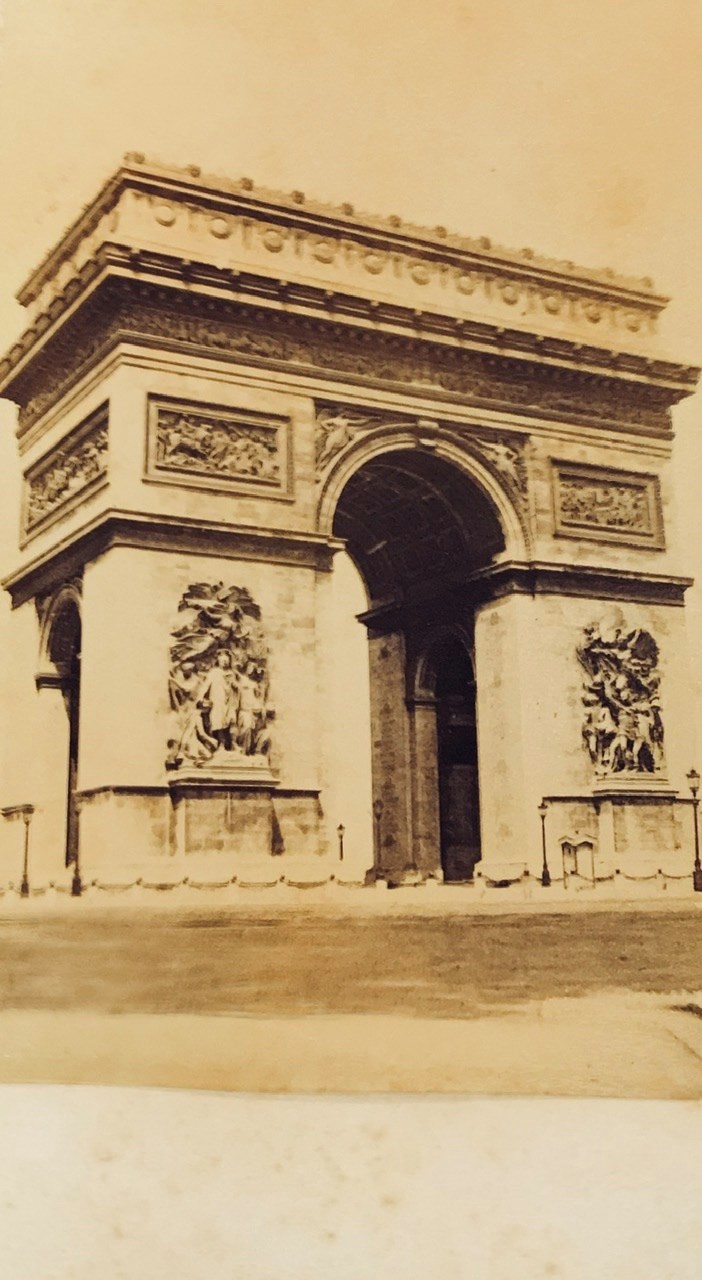
“Arc de Triomphe de l'Étoile”


The name reflects its placement in what was formerly the Place de l’Étoile, a junction of twelve avenues. Like the column in the Place Vendôme, the Arc de Triomphe was built to commemorate Napoleon I’s victory at Austerlitz (1805).


“Le Luxembourg”


Built for Marie de’ Médicis, the mother of King Louis XIII, the Palais du Luxembourg is now the home of the French Senate.


“Tour St. Jacques”


All that remains of the Church of Saint-Jacques-de-la-Boucherie, torn down during the French Revolution, and located at the intersection of the Rue de Rivoli and Rue Nicolas Flamel.


Wednesday, February 21, 2024

Grace La Rue (1882-1956)

Born Stella Parsons, she made her Broadway début in THE TOURISTS (1906), produced by Sam and Lee Shubert. She went on to a long career on Broadway, with occasional forays into film; in 1920 she married Hale Hamilton following a breach of promise suit brought by Hamilton’s second wife, Myrtle Tannehill. 

Both Mlle. Dazie and Grace La Rue appeared in the 1907 and 1908 editions of the ZIEGFELD FOLLIES.

Hale Hamilton (1880-1942)


John Murphy by Athletic Model Guild


Academy Founders 5

N.B. The member numbers follow The Internet Movie Database's list order announcing the Academy in January 1927.


5. (John) Conrad Nagel (1897-1970) of the Actors Branch, fourth president of the Academy, 1932-33. The photo is by Ruth Harriet Louise.


In 1940, Nagel shared a special Academy Award with three others (including Jean Hersholt) for services to the motion picture industry. He also hosted three Academy Awards presentations: comparatively small industry events in 1930 and 1932, and (with Bob Hope) the first televised version, in 1953.

Tuesday, February 20, 2024

Gary Cooper in THE WOLF SONG (1929)


Photos by Alfredo Valente

Alma Kruger (1871-1960) as Lady Catherine de Bourgh in PRIDE AND PREJUDICE (1935-36) on Broadway


Colin Keith-Johnston (1896-1980) as Mr. Darcy


Lucile Watson (1879-1962) as Mrs. Bennet


John Halloran (1907-1997) as Mr. Bingley


And, finally, Percy Waram (1880-1961) as Mr. Bennet

Hollywood at play

As much as the Hollywood studios urged audiences to view film stars as gods and goddesses, another feature of movie publicity was the “star at home” genre. Sometimes this theme bordered on the silly, as with Lew Ayres (middle) being slowly crushed by William Bakewell while sturdy Johnny Mack Brown mugs for the camera.


Monday, February 19, 2024

Fife vs. Feniello


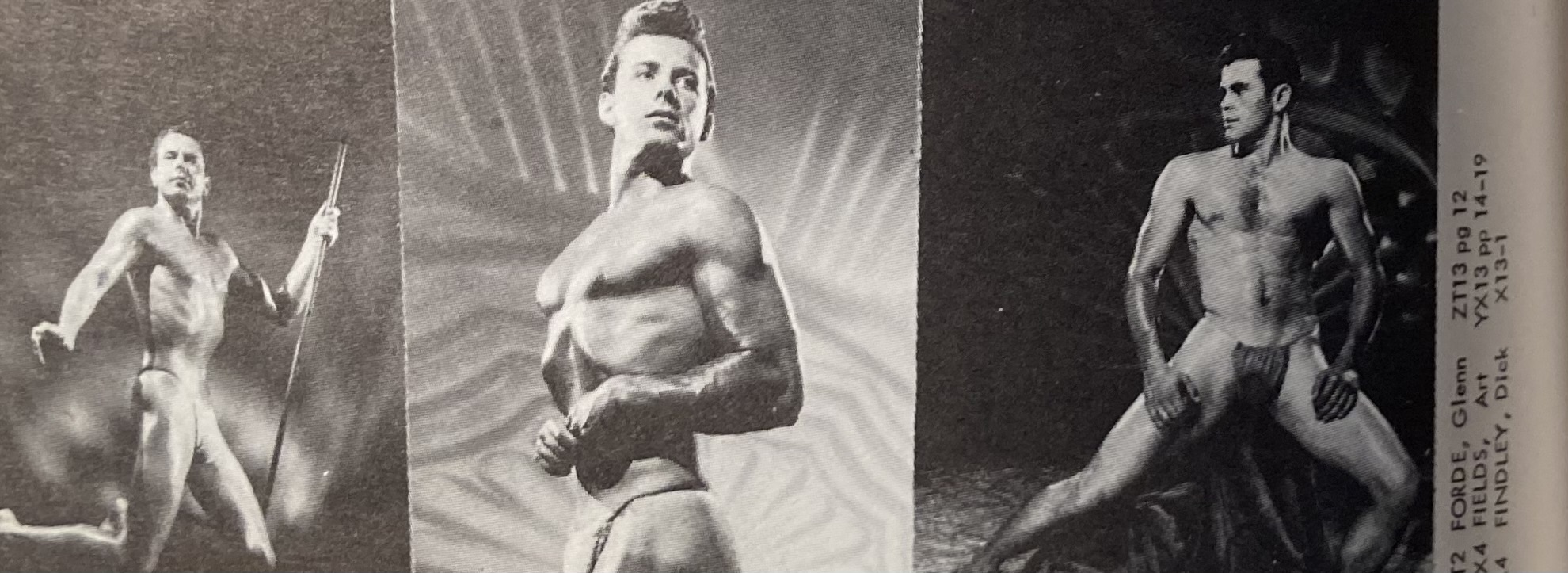
Not the prettiest scans, but here is an example of an inadvertent switch in the AMG Thousand Model Directory that has led collectors astray. No doubt as part of the layout phase, when strips of type were laid down to identify the images, the left and right photos were swapped: Walt Fife is on the top left, Jerry Feniello on the top right; Dick Findley is on the bottom left, and Glenn Forde on the bottom right. 

As usual, the references to pages in the catalogues themselves will sort it out, but the Directory is so helpful, and so readily available, that it is often the default resource when seeking to identify models. Still, Bob Mizer was winging it a lot of the time, and he often renames models — though not, as here, a complete change of identity.

More CDVs

“Pont des Arts Institut” (These cartes de visite are likely by Maison Frêné.)


The first metal bridge erected in Paris (1802-4), it links the Institut de France with the main approach to the Palais du Louvre.


“Côté du Nouvel Opéra”


Today’s Palais Garnier (named for its architect), it was constructed between 1861 and 1875.

“Arc [de Triomphe] du Carrousel”


It was built 1806-8 in the Place du Carrousel to mark Napoleon’s victories in 1805 and as a gateway to the Palais des Tuileries, the imperial residence.


“Les Tuileries”


Begun by Catherine de’ Médicis in 1564, the Palais des Tuileries was a favored French royal (and imperial) residence until it was burned during the Paris Commune in 1871.


Note the line of fiacres, the only human and animal subjects stationary enough to be captured by the camera.


Academy Founders 4

N.B. The member numbers follow The Internet Movie Database's list order announcing the Academy in January 1927.

4. Harold Lloyd (1893-1971) of the Actors Branch, in a photo attributed to Russell Ball (1891-1942).


A comedy star of the same wattage as Charlie Chaplin and Buster Keaton, Lloyd specialized in a comedy of dangerous pratfalls — he was the “normal” youth in every group, the one whose disasters were both funny and educational.


The long sunset of his career was marked by continuing relevance in industry and Hollywood society circles; the Lloyds’ “Greenacres” was, like the Fairbankses’ “Pickfair,” a local showplace. 


He married his co-star Mildred Davis (1901-1969) in 1923.


Sunday, February 18, 2024

The crowd at Muscle Beach


Mademoiselle Dazie

The storied Ziegfeld Follies began as a replacement show after Anna Held’s A PARISIAN MODEL (1906) closed in June 1907. The New York Times reviewed THE FOLLIES OF 1907, a “musical review,” as “a complete change in the bill” after it opened at the Jardin de Paris, atop the New York and Criterion Theatres, although it shared a chorus with the earlier show. Like Miss Held’s show, it was produced by Florenz Ziegfeld Jr.; this program was “another one of those things in thirteen acts.” 


Emma Carus starred as Topsy, “a soubrette lady” (among other roles); the featured performers in the first FOLLIES included Mlle. Dazie as Dolly and as Salome, a dancer.


Mlle. Dazie (Daisy Ann Peterkin, 1884-1952) by Emil Otto Hoppé (1878-1972)


First billed in vaudeville as “The Red Domino” (for a disguising domino mask), she remade herself as Mademoiselle Dazie; this print bears the legend “the toe dancer” (or ballerina) on the reverse. In 1913, she married Cornelius Fellowes, president of the St. Nicholas Hygeia Ice Company, but only announced the event in 1914. (Fellowes sounds like a model for Osgood Fielding in SOME LIKE IT HOT, although this marriage, his second, seems to have lasted.) 


Mademoiselle Dazie’s earliest appearance on Broadway was in 1900, as a specialty dancer in THE BELLE OF NEW YORK.

Photos by Alfredo Valente

Adrianne Allen (1907-1993) as Elizabeth Bennet in PRIDE AND PREJUDICE on Broadway, 1935-36


Joan Tompkins (1915-2005) as Lydia Bennet


Viola Roache (1885-1961) as Mrs. Gardiner


John Davenport Seymour (1897-1986) as Mr. Wickham 


Saturday, February 17, 2024

Cartes de visite

The Church of “La Madeleine,” neighboring the Place Vendôme and the Place de la Concorde in Paris.


The cartes de visite in this group are stamped by Maison Frêné at 222 Rue de Rivoli.


“Fontaine de St. Sulpice” in the Place Saint-Sulpice, designed by the architect of Napoleon I’s tomb.


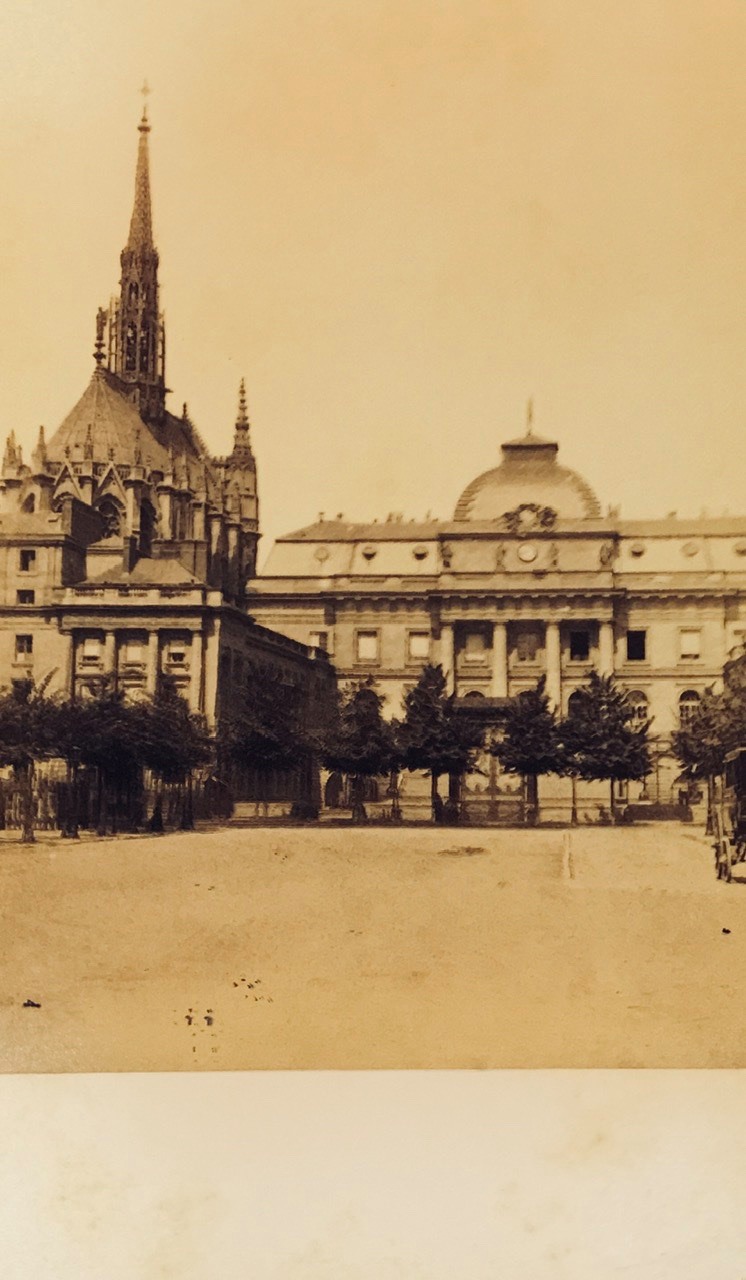
“Ste. Chapelle et palais de Justice”


Sainte-Chapelle was consecrated in 1248; the Palais de Justice, formerly the Palais de la Cité — the seat of French government for a period ending with the Revolution — was largely rebuilt by Georges-Eugène Haussmann.


“La Bourse,” or stock exchange, in the Place de la Bourse. Located at various addresses from 1724, it found a permanent home in the Palais Brongniart (1808-26); in 2000 the bourse became Euronext Paris.


I spy a couple of flâneurs sitting above the steps ... and two more chatting between the columns.